
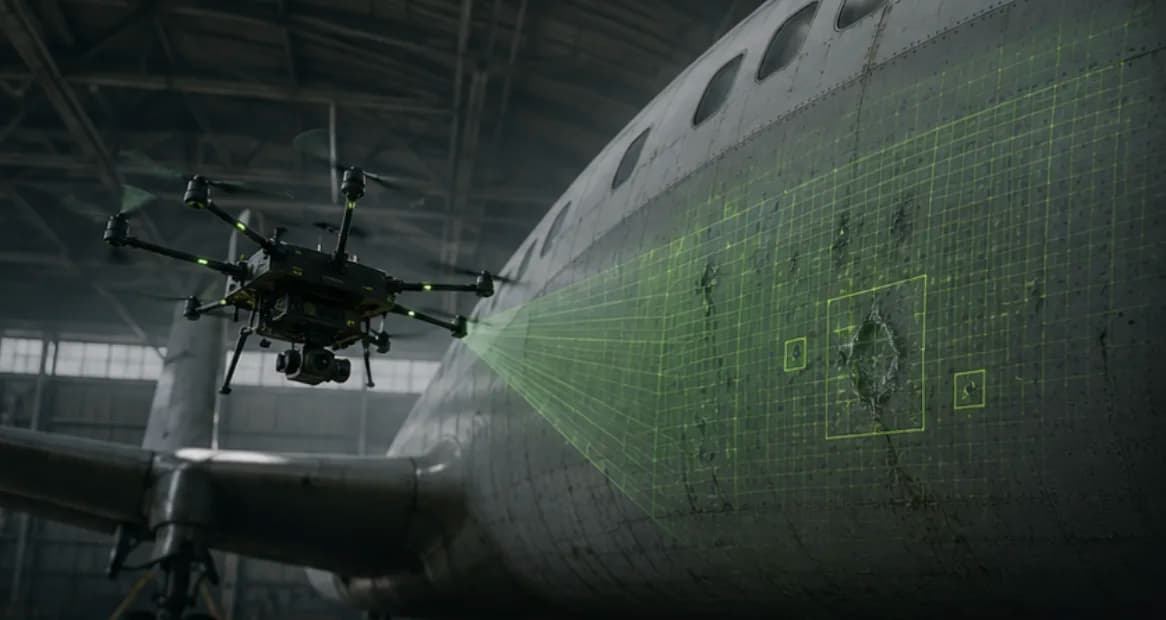
We developed a fault analysis model for aircraft equipment and fuselages for Skoltech’s UAV labs. The model is part of the firmware of a drone that scans the surface of an aircraft parked in a hangar. It determines each defect’s surface area, type, and severity.
The defining constraint was a small training set of rare, non-public data. We collected the data ourselves before developing the model. The task also required optimizing for the limited resources of the edge device (the UAV).
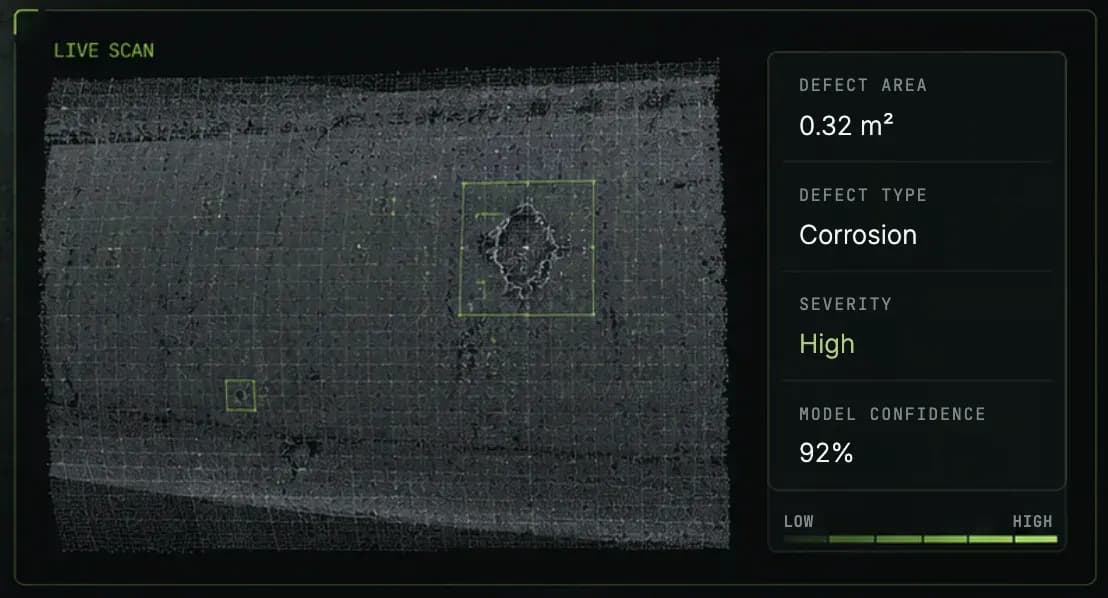
The firmware with the AI model is adapted to an off-the-shelf UAV platform built on a Raspberry Pi single-board computer. It processes the incoming image stream (short buffer) and transfers data to the client’s server (long buffer), where the data is stored. This keeps the system centralized as it scales and makes retraining easy. Data from the server drives the severity metrics shown in the web interface.
- 0101
Data collection & preparation
Building a multimodal dataset of aircraft faults.
- 0202
Edge system architecture
Designing a lightweight ML model to run on a Raspberry Pi.
- 0303
AI model development
Building a system that analyzes and recognizes critical aircraft failures.
- 0404
Performance optimization
Reducing device load and speeding up inference on embedded hardware.
- 0505
Sensor & interface integration
Connecting cameras, diagnostic systems, and data display interfaces.
- 0606
Testing & validation
Testing the model on real-world scenarios and verifying its stability.
- 01Python
- 02TensorFlow Lite
- 03MQTT
- 04Raspberry Pi
- 05OpenCV
- 06YOLO World
- 07UAV
- 08ONNX
Have a similar challenge?
We’ll review it and estimate within 5 business days.